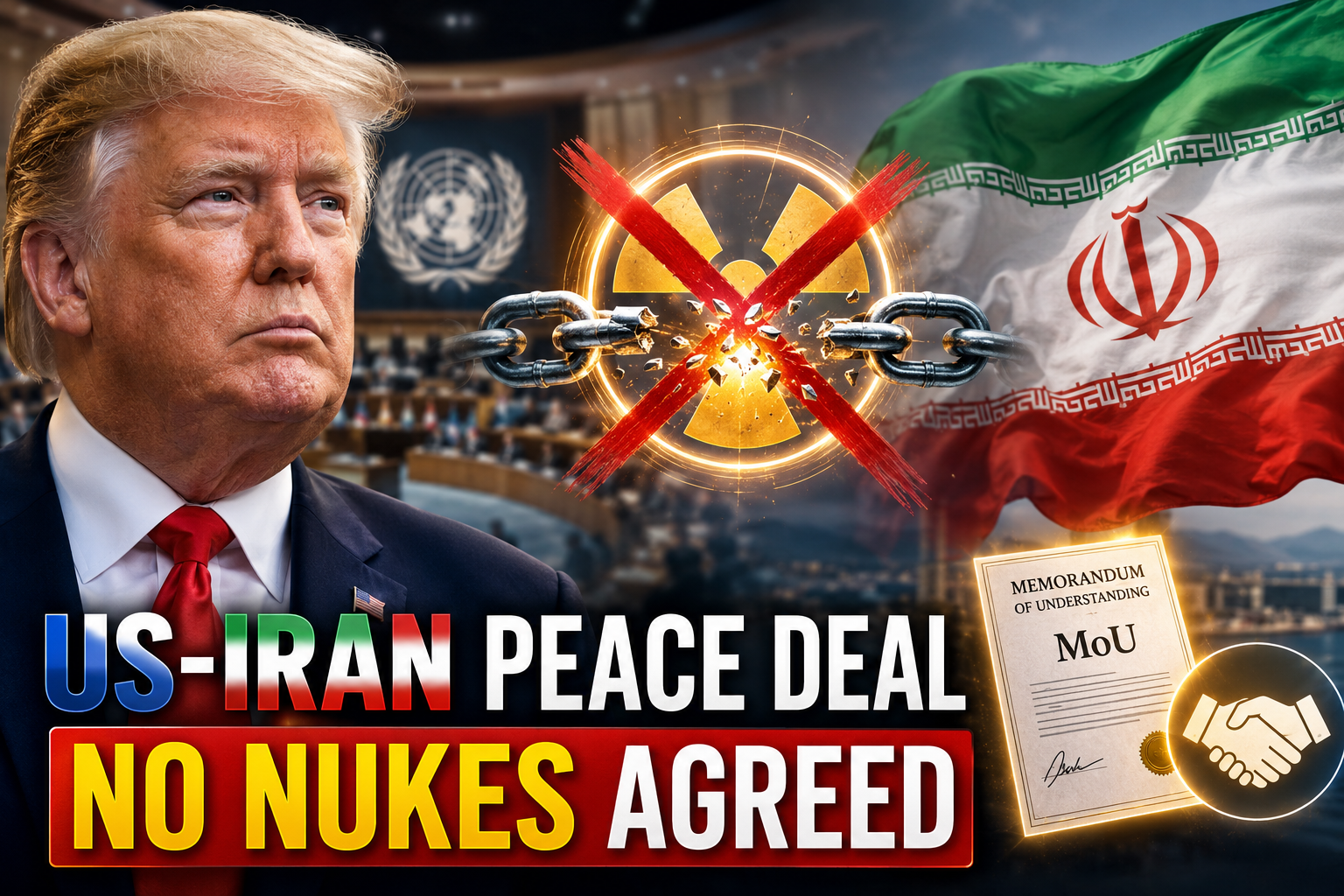
If you have been keeping an eye on global news over the last few months, you already know that the situation in the Middle East has been nothing short of a rollercoaster. For over 100 days, the conflict has kept the entire world on edge. But just when it felt like the tension couldn’t get any tighter, a major diplomatic breakthrough has emerged.
US President Donald Trump recently took to the internet to drop a massive update regarding the ongoing negotiations between Washington and Tehran. In a straightforward message, Trump declared that Iran has officially agreed to “never have a Nuclear Weapon.” Alongside this bold claim, he quickly shut down swirling rumors about the US handing over a massive $300 billion reconstruction fund to Iran, calling it absolute “Fake News.”
But what exactly is going on behind closed doors? Are we finally seeing the light at the end of the tunnel for the US-Iran conflict, or are the details still too blurry? In this article, we will break down everything you need to know about the upcoming Memorandum of Understanding (MoU), the controversy surrounding the alleged billion-dollar payments, and what this means for the rest of the world.
The Big Announcement: “No Nukes for Iran”
Let’s start with the biggest headline. Over the weekend, Donald Trump made a definitive statement on his social media platform, Truth Social, stating that a historic understanding has been reached. He wrote, “Iran has agreed to never have a Nuclear Weapon!”
For decades, the international community has been deeply concerned about Iran’s nuclear program. The fear that highly enriched uranium could be weaponized has been a major sticking point in Middle Eastern diplomacy. By openly stating that Iran has agreed to completely step away from building nuclear weapons, Trump is setting the stage for what could be one of the most significant foreign policy shifts of this decade.
However, as anyone who follows international politics knows, a statement on social media is just the tip of the iceberg. The real challenge lies in the official paperwork and the enforcement of these promises.
The $300 Billion Controversy: Fake News or Misunderstood Facts?
Alongside the nuclear announcement, Trump used his platform to aggressively dismiss a rumor that has been causing an uproar online. Reports had been circulating that as part of the peace agreement, the United States was planning to pay Iran a staggering $300 billion (though Trump’s post explicitly mentioned “300 million Dollars”) to help rebuild the country after the extensive damage caused by recent military strikes.
Trump did not mince words. “Also, the story that the US is paying Iran 300 million Dollars is Fake News, put out by the Dumocrats,” he posted.
So, where did this number come from? According to various international news reports, Iranian negotiators initially floated the idea of a massive reconstruction fund to rebuild their war-torn infrastructure. The idea was that this fund could potentially be supported by Gulf Coast coalition countries or through the unfreezing of Iranian assets held abroad, rather than coming directly out of the US taxpayers’ pockets.
However, Trump’s strong denial makes it clear: his administration is entirely distancing itself from any narrative that paints the US as simply writing a massive check to Tehran.
Inside the US-Iran Peace Deal and the Upcoming MoU
To understand the full picture, we have to look at the upcoming Memorandum of Understanding (MoU). The United States and Iran have reached a preliminary framework to halt the conflict, which is expected to be formally signed on Friday, June 19, in Geneva, Switzerland.
This interim peace deal is essentially a roadmap. It doesn’t solve every problem overnight, but it hits the pause button on the fighting. According to sources monitoring the negotiations, the agreement will kick off a 60-day negotiation period. During this window, both sides will sit down to iron out the finer, more complex details of the peace treaty.
The current MoU reportedly covers:
- A complete ceasefire on all military fronts.
- The lifting of naval blockades, allowing trade to resume.
- A pathway to sanctions relief for Iran—but only if strict conditions are met.
JD Vance Steps In: “Not a Dime Without Performance”
If you are wondering how the US plans to hold Iran accountable, Vice President JD Vance recently provided some clarity. Speaking to major news outlets like ABC News, Vance fiercely defended the administration’s strategy, ensuring the public that this is a “performance-based” model.
“And what everybody will see is that Iran doesn’t get a dime of money unless they perform their obligations,” Vance stated clearly.
Vance reiterated that Trump’s diplomatic strategy is paying off. By linking any economic relief or the unfreezing of assets directly to Iran’s verifiable actions, the administration aims to prevent any loopholes. The Vice President also emphasized that stopping Iran from getting a nuclear weapon has always been the central objective of these negotiations, echoing Trump’s earlier sentiments.
Unanswered Questions: Who Monitors the Nuclear Sites?
While the political rhetoric is confident, weapons experts and geopolitical analysts are asking the tough questions. The Trump administration has yet to fully explain the logistical details of how this nuclear ban will be enforced.
For example, who will be responsible for physically going into Iran to verify that they are complying with the rules? Furthermore, what happens to the highly enriched uranium that is currently believed to be buried deep underneath nuclear facilities? During the recent conflict, US strikes badly damaged several of these sites, making the extraction and disposal of nuclear material a highly complex and dangerous task.
International agencies like the International Atomic Energy Agency (IAEA) will likely need to be heavily involved. Returning their inspectors to Iranian soil will be a crucial first step during the upcoming 60-day negotiation window. Until these inspectors can verify that the uranium is being safely destroyed or removed, the “No Nukes” promise remains a verbal commitment waiting for physical proof.
Why This Matters to India and the Global Economy
You might be sitting in Mumbai, Delhi, or Bengaluru wondering, “How does a US-Iran peace deal affect me?” The answer lies in the global economy and your daily commute.
The recent 100-day conflict severely disrupted shipping lanes, particularly the Strait of Hormuz—one of the world’s most critical checkpoints for global oil supplies. When the Strait was blocked, international oil prices skyrocketed, which directly impacted fuel prices in India.
With this new MoU, the naval blockades are expected to be lifted, and the Strait of Hormuz will reopen for free navigation. For an energy-hungry economy like India, a stable Middle East means stabilized crude oil prices, which can help keep inflation in check. Additionally, millions of Indians live and work in the Middle East. A de-escalation of war brings safety and job security to the vast Indian diaspora in the Gulf region.
Key Takeaways
- No Nuclear Weapons: Donald Trump announced that Iran has formally agreed to never acquire or build nuclear weapons as part of the new peace framework.
- The $300 Billion Denial: Trump strongly dismissed rumors that the US would pay Iran a $300 billion (or million) reconstruction fund, labeling it as “Fake News.”
- Performance-Based Deal: Vice President JD Vance clarified that Iran will only receive sanctions relief or access to frozen funds if they strictly meet their obligations.
- The Geneva Signing: An official Memorandum of Understanding (MoU) is scheduled to be signed on Friday, June 19, triggering a 60-day detailed negotiation phase.
- Global Economic Relief: The peace deal paves the way for reopening the Strait of Hormuz, which is expected to stabilize global oil prices and benefit economies worldwide, including India.
Conclusion
The announcement of the US-Iran peace deal marks a historic turning point after months of intense global anxiety. By securing a promise from Iran to abandon its nuclear weapons ambitions, the Trump administration is claiming a massive diplomatic victory. However, as with all major geopolitical shifts, the devil is in the details.
Over the next 60 days, the world will be watching closely to see how the United States and international inspectors enforce these promises. While rumors of a $300 billion US payout have been squashed, the actual cost of peace—and how Iran will be monitored—remains to be seen. For now, the prospect of a ceasefire and stabilized global oil markets offers a much-needed breath of fresh air for everyone, from world leaders to everyday citizens tracking the news from home.
FAQ Section
1. Did the US agree to give Iran $300 billion for reconstruction?
No. President Donald Trump has firmly denied this claim, calling it “Fake News.” While Iranian media suggested a reconstruction fund might be established, US officials have clarified that no direct US taxpayer money is being handed over to Iran.
2. What did Iran agree to regarding nuclear weapons?
According to statements from the US administration, Iran has agreed to never acquire, develop, or possess a nuclear weapon as a fundamental condition of the interim peace deal.
3. When will the official peace deal be signed?
A preliminary Memorandum of Understanding (MoU) is scheduled to be formally signed on Friday, June 19, in Geneva. This will kick off a 60-day period for negotiating the final, permanent treaty.
4. How will the US ensure Iran keeps its promise?
Vice President JD Vance explained that the agreement is entirely “performance-based.” This means Iran will not receive any sanctions relief or access to frozen funds until international inspectors verify their compliance.
5. How does this peace deal impact the rest of the world?
The agreement includes a ceasefire and the lifting of naval blockades, particularly in the Strait of Hormuz. This allows the safe passage of global oil supplies, which is expected to lower and stabilize international fuel prices, benefiting economies globally, including India.