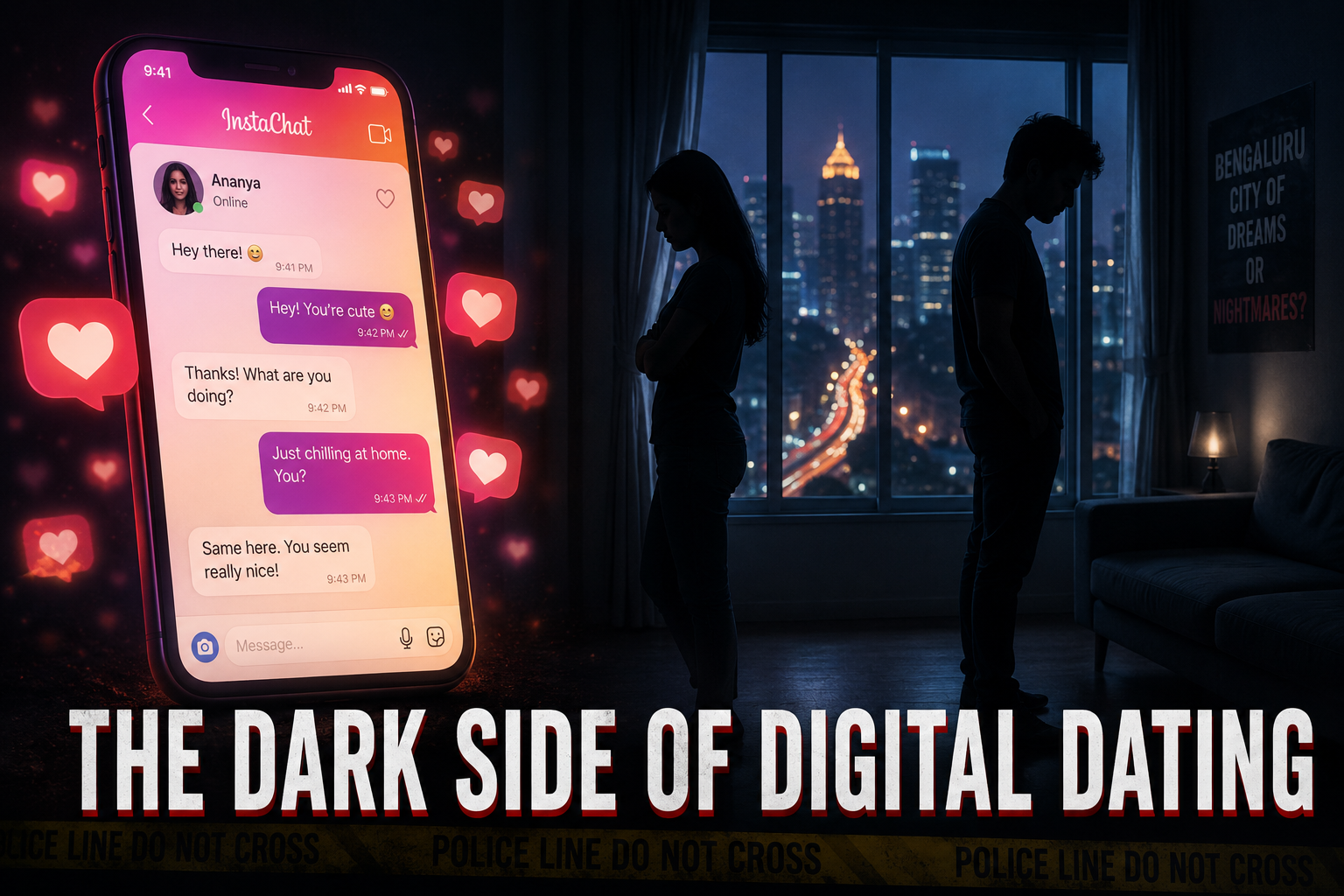
In today’s digital age, falling in love is often just a swipe, a double-tap, or a direct message away. Social media platforms like Instagram have become the modern-day coffee shops where young people meet, connect, and dream of a future together. But what happens when the person behind the screen isn’t who you thought they were?
A chilling incident from Bengaluru has once again forced us to confront the dark reality that can sometimes lurk behind the glossy filters of social media romance. A 20-year-old woman lost her life, allegedly at the hands of her 27-year-old live-in partner, in a tragedy that has left the city in shock.
Let’s take a closer look at what happened in Malleswaram, how a modern romance turned fatal, and the crucial lessons we must all learn about safety in relationships.
The story begins like countless modern romances do. Anusha, a 20-year-old, and Sharath, a 27-year-old, were both originally from the picturesque town of Sakleshpur in Karnataka’s Hassan district. Despite hailing from the same region, their paths crossed on a platform that transcends physical boundaries: Instagram.
They started chatting, the friendship blossomed, and eventually, they decided to take the leap from the virtual world to the real one. Seeking better opportunities and a life together, the couple moved to the bustling IT hub of Bengaluru. For the past six months, they had been sharing an apartment in the well-known neighborhood of Malleswaram.
Sharath took up a job as a water tanker driver to make ends meet. From the outside, it might have looked like a young couple striving to build an independent life in a big city. But behind closed doors, things were far from perfect.
According to the police, tensions had been brewing between the couple over personal issues. When two people move to a new city, away from the safety net of their families, financial stress and personal disagreements can easily amplify.
On a fateful Saturday night, an argument broke out between Anusha and Sharath. What started as a verbal dispute quickly escalated into unimaginable violence. In a fit of rage, Sharath allegedly strangled Anusha to death inside their shared home.
The most chilling part of this crime is what followed. For two days, the incident remained hidden behind the walls of their Malleswaram residence. It wasn’t until Monday that the burden of the crime seemingly caught up with Sharath. Instead of fleeing or going to the police, he contacted his lawyer and confessed to what he had done.
Understanding the gravity of the situation, the lawyer immediately alerted the authorities. Officers from the Seshadripuram Police Station rushed to the scene, where they discovered Anusha’s body. The police quickly launched a search operation, apprehended Sharath, and registered a formal case. Following necessary legal procedures, Anusha’s body was handed over to her grieving family, while Sharath was taken in for intense interrogation.
This tragic incident is not an isolated one. Across India, we are seeing a rising trend of young couples moving away from their hometowns to live together in metropolitan cities like Bengaluru, Mumbai, and Delhi. While urban migration offers freedom and career opportunities, it also strips away a crucial layer of protection: community and family support.
When you live miles away from your parents and childhood friends, your partner often becomes your entire world. If that relationship turns toxic or abusive, the victim can feel completely isolated, with nowhere to run and no one to confide in.
According to data routinely published by the National Crime Records Bureau (NCRB), crimes against women by intimate partners remain a significant concern in India. The transition from a digital friendship to a live-in relationship requires immense trust, but it also demands severe caution.
A common misconception in India is that women in live-in relationships have no legal backing if things go wrong. This is entirely false. The Indian legal system recognizes live-in relationships, and women are protected under the law.
If you are facing abuse from a live-in partner, you have rights under the Protection of Women from Domestic Violence Act, 2005. This act categorizes physical, emotional, verbal, and economic abuse by a live-in partner as a punishable offense.
Furthermore, if you ever feel threatened, the National Commission for Women (NCW) operates dedicated helplines and portals to assist women in distress, regardless of their marital status. You do not need a marriage certificate to report abuse and seek police protection.
Anusha’s untimely death is a grim reminder that we need to educate our youth about relationship safety. Abuse rarely starts with physical violence; it usually begins with subtle behavioral patterns. If you are dating someone you met online, watch out for these red flags:
- Extreme Isolation: If your partner discourages you from talking to your family, friends, or coworkers, they are trying to cut off your support system.
- Digital Surveillance: Demanding your phone passwords, constantly checking your Instagram DMs, or tracking your location is not “love”—it is control.
- Explosive Temper: Notice how they react when things don’t go their way. If minor inconveniences lead to screaming matches or throwing things, it’s a warning sign of future violence.
- Financial Control: If you are forced to hand over your earnings or if your partner secretly drains your shared funds, you are experiencing economic abuse.
- The “Jekyll and Hyde” Persona: If your partner is incredibly sweet in public but cruel and demeaning behind closed doors, trust your instincts. This manipulation is designed to make you question your own reality.
If you are planning to move to a new city with someone you met online, you must prioritize your safety. Here are practical steps to ensure you are protected:
- Keep Family in the Loop: Always share your exact residential address with at least one trusted family member or close friend. Let them know your daily routine.
- Maintain Financial Independence: Have your own bank account that your partner cannot access. Always keep an emergency fund that can buy you a ticket home or a hotel room for a few nights.
- Verify Their Background: It sounds harsh, but when meeting someone via Instagram, do a background check. Verify their hometown, their job (like Sharath’s job as a water tanker driver), and their real name.
- Know Your Emergency Numbers: In India, dial 112 for the National Emergency Helpline. Save the local police station’s direct number on your speed dial.
Key Takeaways
- A 20-year-old woman, Anusha, was allegedly strangled by her 27-year-old live-in partner, Sharath, in Bengaluru.
- The couple met on Instagram, hailed from Sakleshpur, and had been living in Malleswaram for six months.
- The crime was uncovered when the accused confessed to his lawyer, who then alerted the Seshadripuram police.
- Social media romances require careful vetting before transitioning to real-life commitments.
- Women in live-in relationships in India have strict legal protections against domestic violence.
Conclusion
The Bengaluru horror story of Anusha and Sharath is a heartbreaking wake-up call. Social media is a fantastic tool for networking and making friends, but it only shows us a curated, filtered version of a person. When we invite a digital acquaintance into our real, physical lives, we must do so with our eyes wide open.
No argument should ever end in the loss of life. As a society, we need to foster an environment where young people feel comfortable reaching out to their families or helplines the moment they sense danger in a relationship, without the fear of judgment. Let this tragic incident be a reminder: your safety is always more important than a relationship.
Frequently Asked Questions (FAQ)
1. What happened in the Bengaluru Malleswaram murder case?
A 27-year-old man named Sharath allegedly strangled his 20-year-old live-in partner, Anusha, to death after an argument over personal issues at their Malleswaram residence.
2. How did the Bengaluru couple meet?
According to police reports, Anusha and Sharath, both natives of Sakleshpur in the Hassan district, met and became friends through the social media platform Instagram.
3. Are live-in relationships legal in India?
Yes, live-in relationships are legally recognized in India. The Supreme Court has clarified that consenting adults have the right to live together, and it is not considered an offense.
4. Does the law protect women in live-in relationships from abuse?
Absolutely. Women in live-in relationships are protected under the Protection of Women from Domestic Violence Act, 2005. They can seek legal recourse, protection orders, and financial maintenance if subjected to abuse.
5. How was the Malleswaram crime discovered by the police?
The crime occurred on a Saturday night. It came to light on Monday when the accused, Sharath, confessed the incident to his lawyer. The lawyer promptly informed the Seshadripuram police, who then recovered the body and arrested the accused.